
USP 797 & 800 sterile cleanrooms.
Sterile compounding requires uncompromising mechanical precision. Our Coral Springs facility features dedicated positive-pressure buffer areas for non-hazardous sterile admixtures and negative-pressure containment suites for hazardous drugs — verified by independent ISO 14644 third-party certification.
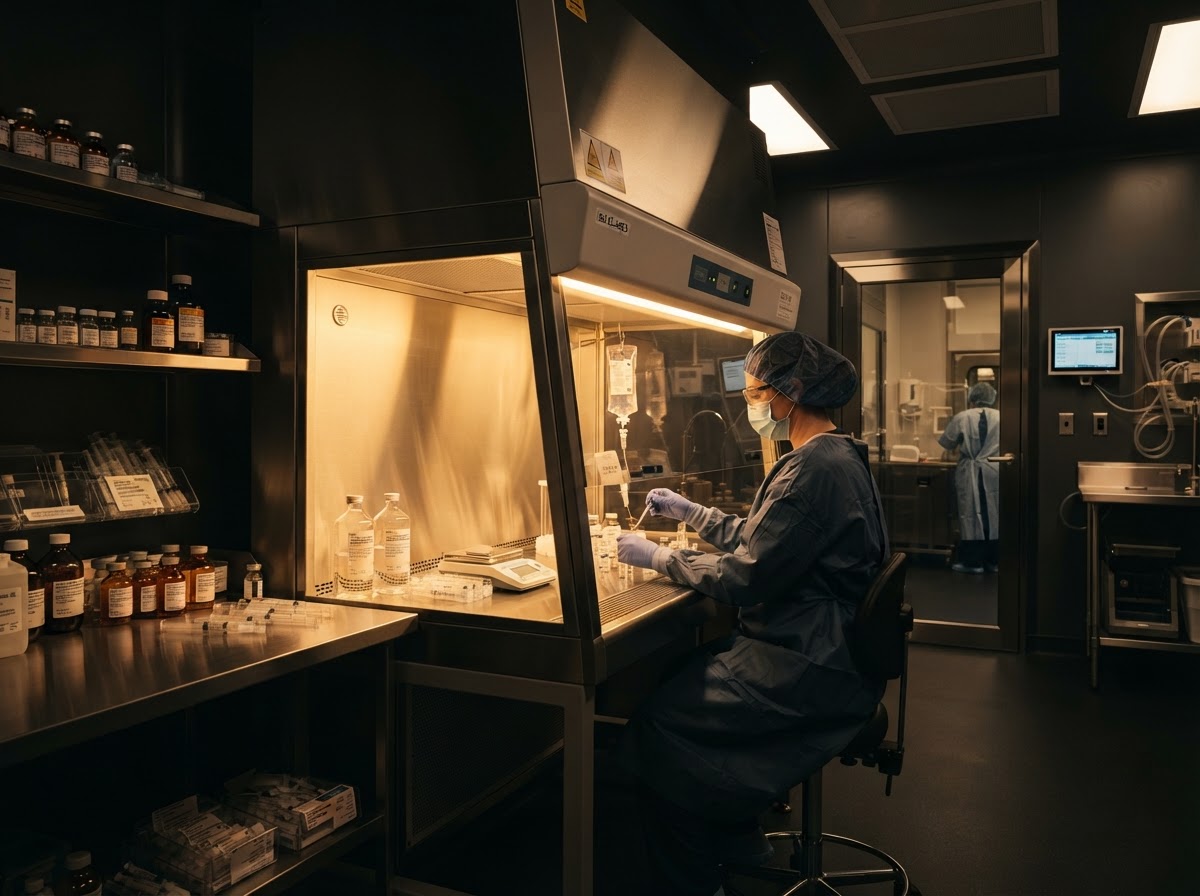
Controlled environment specifications.
Every detail engineered to prevent particulate ingress, cross-contamination, and microbial growth.
USP <797> Sterile Compounding
Non-hazardous sterile admixtures & patient-specific preparations
Dedicated positive-pressure buffer areas engineered for non-hazardous sterile compounding, certified by an independent third party every six months.
Engineering Details & Protocols
- ISO Class 5 laminar airflow workstations within a positive-pressure buffer room
- Ante-room with segregated hand hygiene, garbing, and staging zones
- Third-party semiannual certification of air quality, surface, and glove sampling
- Daily pressure-differential logging and continuous particle monitoring
USP <800> Hazardous Drug Handling
Negative-pressure containment for hazardous sterile preparations
A separately engineered negative-pressure containment suite for hazardous drug compounding, protecting personnel, patients, and the environment.
Engineering Details & Protocols
- Negative-pressure containment primary engineering control (C-PEC) with external exhaust
- Segregated hazardous drug storage with spill containment and secondary packaging
- Closed-system transfer devices (CSTDs) for all hazardous admixture manipulations
- Personnel competency testing and surface decontamination protocols
Laminar Flow & HEPA Filtration
ISO Class 5 unidirectional airflow at the point of compounding
Class 5 laminar airflow hoods deliver filtered, unidirectional air across the critical compounding site, eliminating airborne contamination risk.
Engineering Details & Protocols
- ISO Class 5 (Class 100) laminar flow workbenches with HEPA-filtered supply
- 0.3-micron particulate efficiency rated at 99.97% or greater
- Unidirectional airflow verified across the entire work surface
- Pre- and post-filtration pressure monitoring with alarm interlocks
Environmental & Particle Monitoring
Continuous certification, sampling, and trend analysis
Continuous environmental monitoring — viable and non-viable — with documented trending to prove sustained sterile conditions over time.
Engineering Details & Protocols
- Continuous viable air sampling and surface contact-plate culturing
- Non-viable particle counters with real-time alert thresholds
- Certification, certification, and recertification logs maintained per USP
- Environmental trending reports reviewed by the designated person (DP)
Cold-Chain & Temperature Control
Refrigerated storage, monitoring, and back-up power
Temperature-controlled refrigerated and frozen storage with 24/7 monitoring, alarms, and redundant back-up power for product integrity.
Engineering Details & Protocols
- USP-defined refrigerated (2–8°C) and frozen storage with continuous monitoring
- Calibrated digital data loggers with out-of-range alarm notification
- Back-up generator and uninterruptible power supply (UPS) for all storage
- Documented temperature excursion response and product quarantine procedures
Automated TPN Compounding
Gravimetric verification and robotic admixture
Automated compounding devices and gravimetric verification ensure precise, reproducible total parenteral nutrition formulations for every patient.
Engineering Details & Protocols
- Automated compounders for dextrose, amino acid, lipid, and electrolyte admixture
- Gravimetric verification of every component against the patient-specific formula
- Barcode-driven ingredient selection to prevent wrong-drug errors
- Patient-specific labeling with lot, beyond-use date, and storage instructions
Compounding workflow from order to delivery.
A five-stage quality gate ensuring safety, sterility, and exact dosing for every patient.
Prescription Review
A licensed pharmacist reviews each prescription for clinical appropriateness, drug interactions, dosing, and patient-specific requirements.
Sterile Preparation
Garbing and hand hygiene in the segregated ante-room before entry into the buffer area under laminar flow.
Compounding
Patient-specific admixture prepared under ISO Class 5 conditions with barcode-driven ingredient verification.
Verification
Gravimetric and visual verification, labeling with lot and beyond-use dating, and pharmacist final check.
Delivery
Temperature-monitored courier dispatch — same-day, across Tri-County South Florida — to patient, clinic, or facility.
Standards, Accreditations & Compliance
Our facilities follow strict adherence to United States Pharmacopeia chapters and Florida statutory requirements.
USP <797>
Non-hazardous sterile compounding
USP <800>
Hazardous drug containment
ISO Class 5
Laminar airflow workstations
HEPA
0.3-micron high-efficiency filtration
FL Board
Florida Board of Pharmacy licensure
DEA
Controlled substance registration
ACHC / URAC
Third-party accreditation pathways
DSCSA
Track-and-trace supply chain compliance
Continuous cold-chain temperature verification
All sterile admixtures travel in temperature-logged transport with power backup — delivered same-day across Tri-County South Florida to protect critical therapeutic shelf life.
Request cleanroom & SOP documentation.
For accreditation reviews, hospital partner audits, or clinical trial protocol inquiries.